EMIS-2024

Latest news

5.4.2026

At the end of EMIS-2024, we asked one deliberately unserious question. The answers were more revealing than expected.

Across the dataset, the most common responses were not celebrities, but “myself” and “my partner” — far more frequent than any named public figure, including widely recognised actors such as Henry Cavill or Brad Pitt.

Where celebrities did appear, the pattern followed age rather than geography, reflecting generational visibility more than any shared global ranking.

Country differences added some flavour. In Germany, some respondents dismissed the question outright; in the United Kingdom, others met it with a more familiar British sense of humour, welcoming a moment of levity.

Even a playful question, it seems, can say something serious about how attraction works. Read more.

19.03.2026

We are pleased to announce that our EMIS-2024 Methods Paper has now been published in Sexuality Research and Social Policy.

EMIS-2024 builds on our previous survey waves in 2010 and 2017, continuing to generate essential data on the sexual health, wellbeing, and lived experiences of men who have sex with men (MSM), as well as transgender and non-binary people across Europe. These populations remain disproportionately affected by stigma, mental health challenges, HIV, and other sexually transmitted infections, underscoring the need for reliable and comparable data to inform public health action.

With EMIS-2024, the consortium’s collaborative model is now reflected across all three survey waves: in line with EMIS’ core principle of integrating community organisations, academia, and governmental public health institutions, coordination has successively been led by each of these sectors. This is mirrored in the current consortium partners—Deutsche Aidshilfe (community organisation), Maastricht University (academic institution), and Robert Koch Institute (governmental public health institute).

More than 60 partners in 40 countries contributed to the survey, producing 35 language versions and supporting wide dissemination. Conducted online in the first half of 2024, EMIS-2024 collected 165,380 responses, of which 50,330 are included in the analytic sample.

A key strength of EMIS-2024 is its harmonised design, using a shared sampling frame and core questionnaire across countries to enable meaningful cross-national comparisons.

EMIS-2024 demonstrates the continued value of coordinated, multi-country behavioural surveillance and needs assessment with strong community involvement and public funding.

26.02.2026

The latest report from the European Centre for Disease Prevention and Control (ECDC) summarises 2024 data from 29 EU/EEA countries on STI prevention and control, structured around enabling environment, prevention, testing and treatment, and aligned with the 2025 interim targets of the WHO Regional Office for Europe Action Plan 2022–2030.

Importantly, the analysis draws on findings from EMIS-2024. By integrating community-reported behavioural data with national monitoring indicators and surveillance systems such as European Gonococcal Antimicrobial Surveillance Programme, the report strengthens the evidence base for scientists, public health professionals and community stakeholders working to advance STI prevention across Europe.

11.12.2025

Chemsex—the intentional use of psychoactive stimulant substances to enhance and prolong sexualised social encounters—has emerged as a significant public health issue in recent years. AIDS service organisations have responded with targeted support services, alongside training for counselling, peer support, and self-help. Effective planning of health interventions requires robust estimates of how many people experience health impairments related to substance use in sexual settings, as these figures directly inform resource allocation across prevention, counselling, self-help, and therapeutic care. Drawing on data from EMIS-2024 and population estimates, this analysis maps the prevalence of chemsex-related behaviours across Germany, differentiated by federal states and selected major cities. The findings indicate a substantial gap between existing services and likely needs, pointing to marked underprovision. Expanded and innovative, stigma-reducing approaches are required to improve access and reduce harm [article in German].

24.07.2025

EMIS-2024 Design and Methods Paper Now Available as a Preprint
We are pleased to share the preprint of our EMIS-2024 Methods Paper. This detailed document offers valuable insights for funders and partners working with national EMIS data, helping to better understand the design and implementation of EMIS-2024.

26.06.2025

The First EMIS-2024 Community Report Is Here – Will Be Made Available in 33 Languages!
We’re excited to announce the release of the first EMIS-2024 Community Report, specially created for survey participants and the wider MSM, trans, and non-binary communities. Thanks to the dedicated efforts of our partners and translators, the report is now being made accessible in 33 languages. Dive in and explore some key findings.

18.03.2025

EMIS released 34 indicators through the ECDC for the 2024 Dublin Declaration Monitoring (DDM) report. These indicators apply to MSM (both cis and trans) and individuals assigned male at birth who identify as nonbinary. All indicators are stratified by age group (<25, 25+), with three further stratified by HIV diagnosis. This release occurred ahead of the official data publication to collaborating partners to meet DDM deadlines. As requested in the DDM forms, we provide numerator and denominator counts, along with percentages when the denominator includes at least 20 cases.

14.02.2025

50,330 Respondents

EMIS-2024 recruitment closed on June 30, 2024. It took until February 2025 to merge 35 language versions, process, and clean the data. After cleaning, there are 50,330 respondents with valid data.

This number includes 2,658 individuals who identified as part of the trans community, the highest number recorded across all EMIS waves.

The EMIS-2024 variable manual is now available under publications. We are currently drafting the methods paper, which we hope to have available by summer, and the European Report. National funders will receive the Data Transfer Agreement for their respective national data subsets by the end of February for review and signature. Network members will be notified once the EMIS-2024 Scientific Board is established and data requests are ready to be processed.

Past updates


Project

The European MSM Internet Survey (EMIS) is a multi-country, multi-language, anonymous online survey for gay, bisexual, and other men who have sex with men (MSM).

EMIS is a joint project of community, academic, and governmental partners across Europe, to inform sexual health interventions for MSM. It occurred in 2010 and 2017 with core-funding from the European Union Health Programme. Since October 2023, we have managed to establish sufficient funding for repeating EMIS, with data collection in the first half of 2024.

EMIS-2024 is executed by a consortium of three partners: Deutsche Aidshilfe (DAH), Maastricht University, and Robert Koch Institute (RKI). Team DAH: Dr. Axel J. Schmidt (co-principal investigator), Dr. Tamás Bereczky (coordinator EEA/CH/IL), with the support of Dr. Dirk Sander, Jonathan Gregory, Ferenc Bagyinszky, Alexandra Gurinova, Silke Klumb. Team Maastricht: Prof. Dr. Kai J. Jonas (co-principal investigator), Liana Aphami (data coordinator), Jules L. Casalini (trans sub-survey coordinator). Team RKI: Dr. Ulrich Marcus (co-principal investigator), Dr. Nikolay Lunchenkov (coordinator EECA).

EMIS-2024 is co-funded by the European Centre for Disease Prevention and Control  (ECDC) and the following countries: BE, CH, DE, EE, ES, IE, IL, LU, NL, NO, PT, and SE. For details see EMIS-2024 Network. One of the key benefits of EMIS has been the possibility of completing the questionnaire in all of the official languages of the European Economic Area (EEA). This is particularly important for countries with large proportions of migrants from Southern, Eastern, or South-eastern Europe.

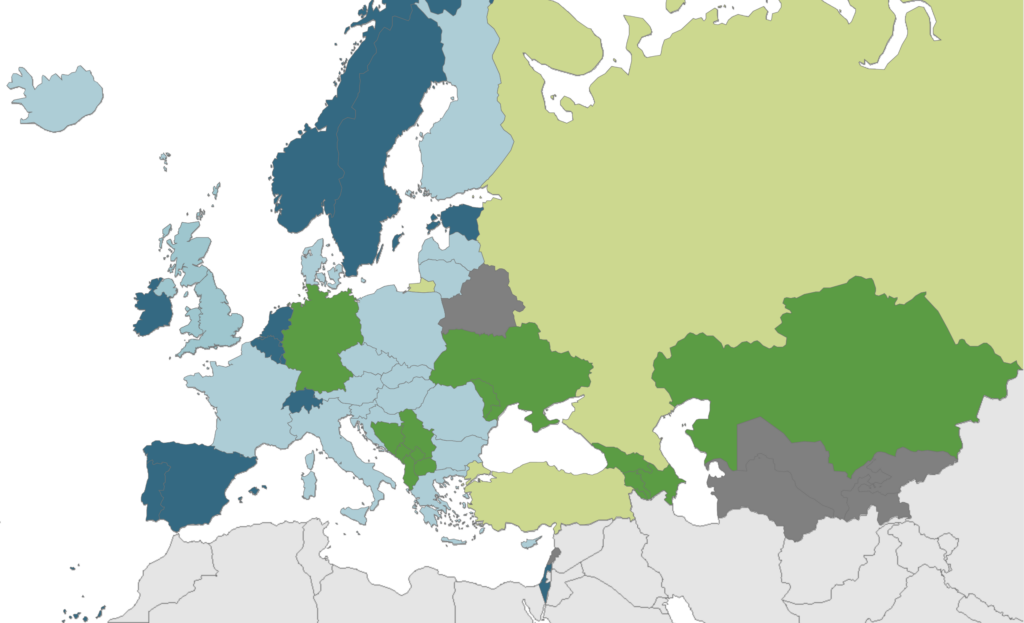
In EMIS-2024 we cover 50 countries and 35 languages.

Countries receiving national funding are shown in dark blue, while those in lighter shades of blue are included without funding, as their national languages are already covered. Countries co-funded by ECDC are highlighted in light green. Countries receiving funding from Germany’s Global Health Protection Programme (GHPP) are highlighted in dark green.

Previous EMIS rounds also included Belarus, as well as Lebanon, Canada, and the Philippines outside the WHO European Region. EMIS was coordinated by Deutsche Aidshilfe (DAH) and Robert Koch Institute (RKI), as illustrated in the following map.

Network
Publications